
 Call Us Now!
 We, at Ashok Polymers, bring to you high-performing PVC Ball Valves with a quarter- turn mechanism. Designed to deliver precision control, our PVC ball valves are extremely durable and economically viable. It offers corrosion resistance and chemical stability- making them the trusted choice for various industrial and domestic applications.
With a focus on precision and consistent quality, Ashok Polymers manufactures PVC ball valves that provide easy installation, leak-proof operation, and minimal maintenance. The products are developed to meet the practical requirements of modern piping systems, making them a dependable choice for residential, agricultural, and industrial use. By maintaining strict quality standards and customer-focused manufacturing practices, Ashok Polymers continues to provide valve solutions that support efficient water management and long-term performance.
What is a PVC Ball Valve?
PVC ball valve is the device designed to regulate the flow of liquids or gases via the piping system. Primarily made from Poly Vinyl Chloride (PVC), it has a spherical disc, termed as the ‘Ball’ having a hole at the center to allow or block the flow whenever the valve is turned.
It functions on the quarter- turn mechanism that allows the ball to rotate at 900 when the handle is turned. When the hole is aligned with the path of flow, it allows the fluid to pass through freely. When it is turned perpendicular, it entirely blocks the flow.
These are widely used in agriculture, plumbing, irrigation, sanitary, farm, horticulture, chemical and green house.
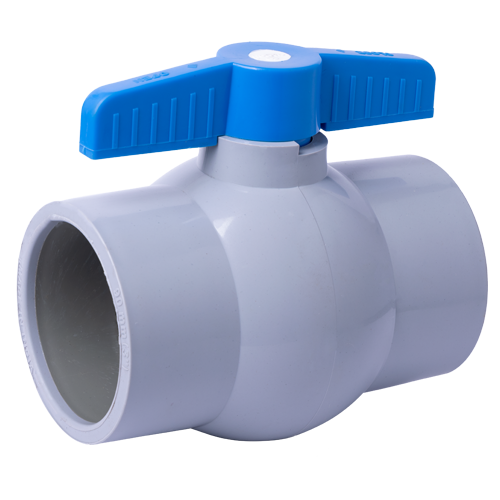
Material and Construction
The PVC ball valves are usually made of-
Ideal for variety of chemicals due to its lightweight and corrosion- resistant properties
Often made of PTFE or EPDM, ensuring leak- proof operation
Connects the handle to the ball and includes O- rings for sealing.
Usually made of smooth PVC and ensures minimal friction and resistance
Usually made of PVC
Key Material Benefits
Safe for potable water systems
Rust- proof material that can withstand chemicals and moisture
Cheaper and easier to transport and install than metal valves
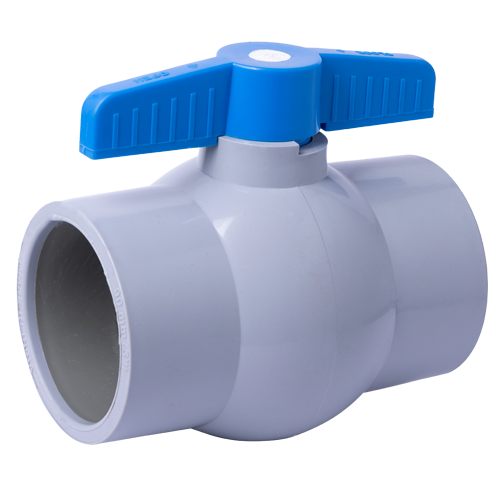
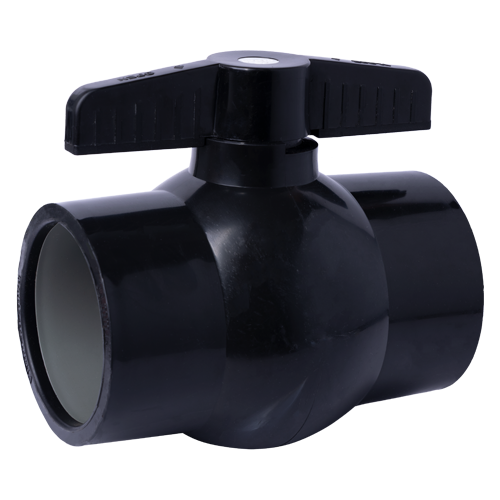
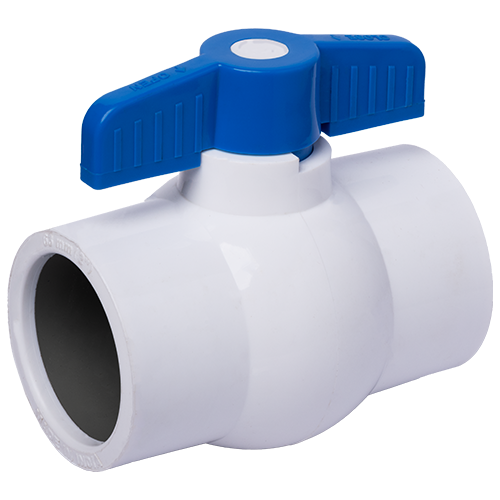
We Manufacture
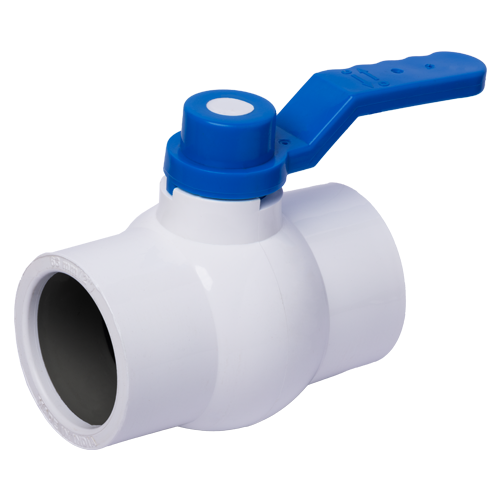
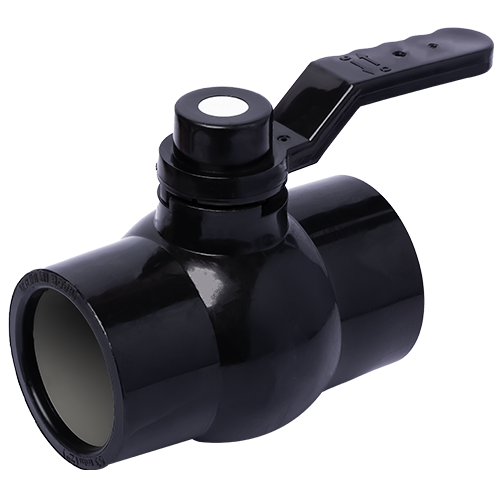
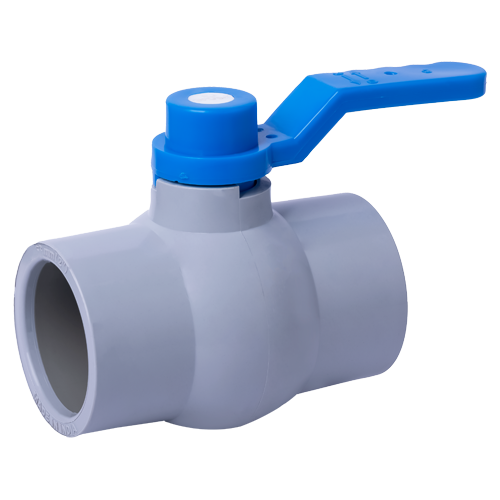
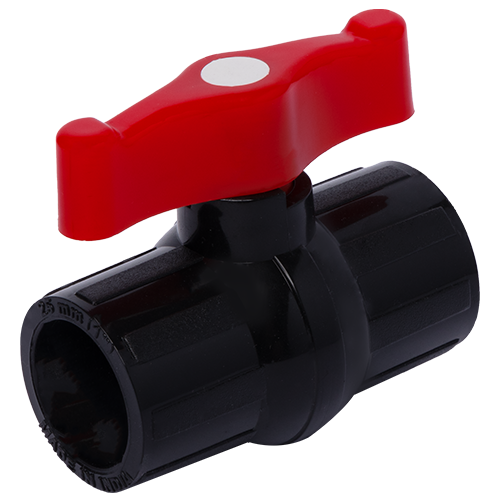
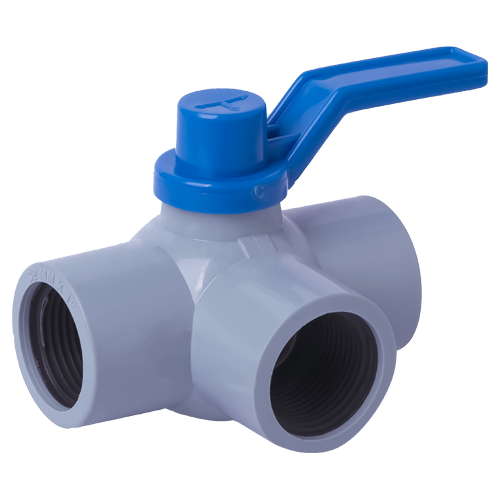
How Does a PVC Ball Valve Work?
To control the flow, PVC ball valves use a rotating ball with a hole inside its body. To function smoothly, it has 2 positions-
When the hole aligns with the pipe and allows the flow.
When the ball rotates 900 and blocks the path of flow.
The handle at the top of the valve reflects the direction of flow-
- Open- When parallel to the pipe
- Closed- When perpendicular to the pipe
It is easy even for non- professionals to operate the valve due to this simple mechanism.
Applications
Professionals from all industries trust our PVC ball valves owing to its durability and versatility and use them in a variety of settings –
- Home plumbing systems
- Garden and lawn irrigation
- Aquariums and water features
- Swimming pools and spas
- Water purification units
- HVAC systems
- Industrial kitchens and cleaning systems
- Fertilizer injection lines
- Drip irrigation and sprinkler systems
- Water tanks and reservoirs
- Laboratory water lines
- Chemical processing plants
- Cooling systems for machinery
- Water and wastewater treatment
Advantages of PVC Ball Valves
PVC material is non-metallic, as such, it does not rust or corrode. This makes it suitable to use especially for handling harsh environments, chemicals, etc.
Being less expensive than their brass or stainless-steel counterparts, PVC valves offer great value without any compromise in its performance.
Chemicals can prove to be hazardous, if not handled well. As such, it is always advisable to check chemical compatibility charts for specific material. Thus, to avoid any danger when using chemicals, PVC is the safe option as it is compatible with a wide range of bases, acids and salts.
As compared to metal valves, PVC valves are much easier to handle and install and thus, are preferred to be used in overhead or complex piping systems.
Due to its durable design and minimal moving parts, PVC ball valves usually require little to no maintenance over their lifetime.
The quarter-turn mechanism allows for a quick and intuitive opening and closing possible.
Limitations of PVC Ball Valves
Prolonged exposure to sunlight can cause PVC to degrade. Thus, it is advisable to use UV-resistant versions of PVC or protective coverings for outdoor use.
The PVC ball valves are usually ideal for use in cold and warm water, chemical solutions and non- steam application. The safe operating temperature range for the PVC ball valve is between 00C – 600C (320F – 1400F). At higher temperatures (i.e., temperature above 600C or 1400F), it begins to soften and as such, the material is not safe to use in hot water or steam systems.
While sufficient for most low- to medium-pressure applications, PVC valves are not suitable for high-pressure industrial systems.
As compared to metals, PVC is more brittle and thus, may crack under extreme mechanical stress or impact.
Installation Guidelines
-
Preparation
Clean and dry all pipe surfaces. Ensure that the valve is of correct size and type.
-
Solvent welding
Apply primer and PVC cement. Insert pipe fully into valve end. Hold for 30 seconds and allow 24 hours to cure before testing.
-
Threaded installation
Use Teflon tape (PTFE) on male threads. Hand-tighten, then apply a wrench for one or two more turns. Avoid over tightening to prevent cracking.
-
Testing
After installation, slowly introduce water. Check for leaks at connections and around the valve handle.
Maintenance Tips
When not in regular use, the valve may get stuck. To prevent the same, occasionally turn the valve.
To avoid any leakage, ensure to check for the leaks around the stem or end connectors.
If the valve is hard to turn, don’t force it. Rather, first check and inspect for debris or damage.
Use UV covers or paint with protective coating if the valves are installed outdoors.
Environmental and Safety Considerations
When certified under NSF/ANSI standards, PVC is considered a safe material for drinking water systems.
However, it is important to note that it can emit toxic fumes in case of fire. Thus, always ensure to use caution whenever installing the PVC valves in indoor environments without proper ventilation.
For eco-conscious users, check for manufacturers who are following sustainable production methods and offer recyclable PVC components.
Why Ashok Polymers?
PVC ball valves are crucial to safety and security of several fluid flow systems. As such, it is crucial to always buy from reputed brands which ensures quality, comply with standards and provides long-term reliability. It is also important to buy only the RIGHT PVC depending upon types, materials, specific use, etc.
We, at Ashok Polymers, are dedicated to help you resolve all your queries and concerns and to guide you to make the right purchase, backed by correct information about the same.
Ashok Polymers have a market edge in manufacturing excellence, thus ensuring that each valve is
- crafted under strict quality control
- certified by industry standards, and
- backed by customer trust.
We are committed to more than just supplying valves- we are enabling smart flow solutions.
