
 Call Us Now!
 Ashok Polymers offers yet another type of ball valve- the RPVC Ball Valve. It is in use widely across industries and is well- known for the excellent balance of cost it offers in addition to its performance and chemical resistance qualities.
What is a RPVC Ball Valve?
RPVC ball valve is a mechanical device primarily made from a thermoplastic polymer known as Rigid Poly Vinyl Chloride (RPVC). Owing to the properties of RPVC material, the device is rigid, strong and resistant to chemicals while regulating the flow of fluids within the piping system.
The design of the valve is quite simple- it includes a ball which is spherical in shape and has a hole at the center and rotating the same within the body of the valve allows or blocks the flow of fluid.
The rotation of the ball at 900 is due to the quarter- turn mechanism that is responsible for regulating the flow of fluid within the system. The flow is blocked when it is perpendicular to the pipe whereas the fluid is allowed to flow through when it is parallel to the pipe.
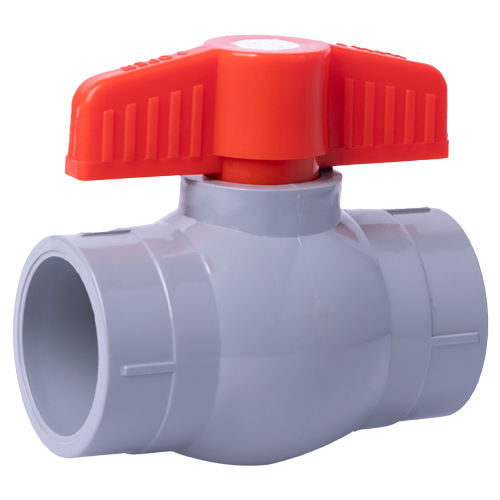
We Manufacture


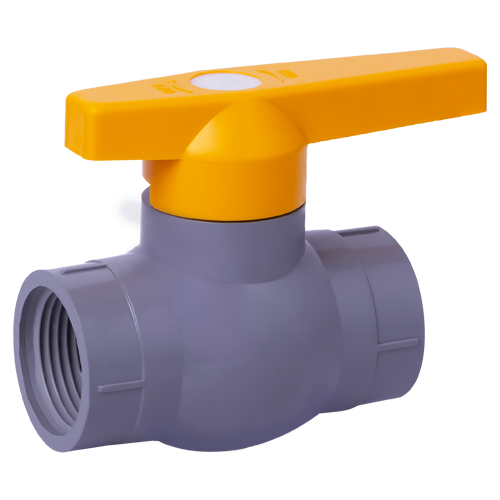
Material and Construction
The RPVC ball valves are usually made of-
The body of these valves are made of RPVC material which is known for its chemical- resistance and rigidity.
These are used for sealing and durability and are made of PTFE or EPDM.
Handles are usually made of RPVC material and available to use as manual handles. However, to make automation possible, pneumatic and electric actuators are also available.
Ball is usually made of RPVC or compatible thermoplastic, thereby reducing friction.
It is made of stainless steel or plastic depending on the design and connects the handle to the ball and includes O- rings for sealing.
Key Material Benefits
RPVC material is more rigid and tougher than the standard PVC. This allows the valve to maintain structure under higher pressures and temperatures.
Being the low conductor of heat, RPVC are used in applications that require specific thermal management.
Being lightweight, these materials are easy to install with the use of solvent welding or threaded fittings and further, requires low maintenance.
RPVC materials do not corrode. Their rust- proof nature allows them to enjoy a longer life and perform consistently in corrosive environments.
Being highly resistant to a wide range of acids, alkalis and salts, RPVC valves are ideal for chemical processes.
As compared to their metal counterparts, RPVC valves are usually less expensive. Thus, it is a cost- effective option without any compromise with the quality.
Applications
Due to its versatility, RPVC valves are in use in several industries-
The most common use of RPVC valves are in flow control in non- potable water systems, HVAC equipment and drainage.
Due to their non- corrosive nature, these valves are in filtration systems and processes such as chlorination and water softening.
These are perfect for aquatic environments since they are highly resistant to chlorinated water and saltwater.
These valves are commonly used in sprinkler and drip irrigation systems due to their durability and lightweight.
Known for resisting a broad range of chemicals, RPVC ball valves are ideal for handling acidic and caustic fluids.
Advantages of RPVC Ball Valves
RPVC material has an advantage over metallic valves because of its nature to withstand corrosive chemicals and moisture in the environment. As such, these are preferred in aggressive applications.
The RPVC ball valves are easy to operate with a simple on-off using the quarter- turn mechanism, thus making it user- friendly.
Being chemical- safe for a range of chemicals, RPVC valves are preferred.
RPVC ball valves are cheaper options as compared to ball valves made of brass or stainless-steel. This makes them budget- friendly options combines with high performance and optimal for low to medium pressure applications.
Being significantly lighter than metal valves, it is much easier to handle and install RPVC valves, thereby significantly reducing transportation and handling costs.
Due to non- metallic, non- corrosive nature, RPVC ball valves are easy to maintain due to minimal risk of rusting or scaling.
Limitations of RPVC Ball Valves
The RPVC ball valves work fine within the safe operating temperature range, i.e. between 00C – 600C (320F – 1400F). Prolonged exposure to temperature above 600C or 1400F causes the material to deform and degrade.
Due to lower pressure ratings as compared to metal ball valves, RPVC valves are not suitable for high-pressure industrial systems.
To avoid situations of degradation of RPVC material of the ball valves due to prolonged exposure to sunlight, it is recommended to opt for UV-resistant variants or use protective coatings.
RPVC material is more brittle in comparison to metals and thus, may crack under extreme mechanical stress or impact. Therefore, it is advisable not to use RPVC ball valves for high- pressure compressed gas applications.
Installation Best Practices
For optimal performance and long durability of RPVC ball valves, following best practices are recommended-
-
Use compatible fillings
To avoid stress cracking, make sure to stick to RPVC or compatible plastics for connections.
-
Avoid excessive torque
Ensure to follow manufacturer’s torque specs to avoid damage that may happen due to overtightening.
-
Pipeline support
Make sure to provide adequate support to piping systems to prevent valve body from cracking due to stress.
-
Allow for Thermal Expansion
It is crucial to note that RPVC expands with temperature and as such, provide for the same in the system design.
Maintenance Tips
RPVC ball valves are low maintenance but to ensure their durability and enhancing their lifespan, make sure to follow these tips-
To prevent the valve getting stuck, it is advisable to occasionally turn the valve especially when the valve is not in regular use.
Check and inspect for crackings, discoloration, leaks or any debris or damage and do not force if the valve is hard to turn.
It is possible that PTFE or rubber seats may wear out over time. As such, make sure to replace them as per usage conditions.
Needless to say, if the valves are installed outdoors, check and use UV covers or paint with protective coating.
To keep the flow run smooth and system supports for a longer duration, periodically flush with compatible cleaning solutions. Follow this especially in chemical systems.
Automation of RPVC Ball Valves
Often it is seen that the systems require remote operations. RPVC ball valves offers this feature as well. This is possible with the use of-
For precise control in automated systems.
Preferred in industrial setups for quick response.
In case of power or air failure.
When automating, ensure actuator torque matches the valve’s operating torque to avoid overloading
Environmental and Safety Considerations
RPVC is recyclable. However, proper segregation and handling is required.
It is safe for many systems to use yet it is not recommended as safe for drinking water, unless certified from concerned bodies.
Although having the property of self- extinguishing, but it can release harmful gases, when burned.
Thus, whenever using or disposing RPVC valves, it is always advisable to follow the local environmental and safety regulations.
Comparison Between UPVC Vs. CPVC Vs. RPVC Ball Valves
|
Feature |
UPVC |
CPVC |
RPVC |
|
Max Temp |
60°C |
93°C |
60°C |
|
Strength |
Moderate |
Higher |
High |
|
Cost |
Low |
Higher |
Moderate |
|
Chemical Resistance |
Good |
Excellent |
Excellent |
|
Best For |
Domestic, irrigation |
High-temp chemicals |
Industrial use |
|
Ideal For |
General purpose, cost-sensitive projects |
High- temperature chemical flows |
Industrial and heavy-duty uses |
Why Ashok Polymers?
RPVC Ball Valves are a practical and economical solution for many fluid handling applications. Their strength, chemical resistance and ease of use make them particularly attractive in industrial and agricultural sectors. Despite their limitations in temperature and pressure, they perform exceptionally well in conditions suited to their material characteristics.
Whether you’re managing an irrigation system or building a chemical plant pipeline, RPVC ball valves can be a smart and durable choice. Due to their significant role in maintaining the safety and security of fluid systems, it is advisable to always buy from reputed brands, ensure the material comply with standards, etc.
In case of any queries, reach out to us at Ashok Polymers to receive the right information and get resolution to all your queries and concerns.
Ashok Polymers have a market edge in manufacturing excellence, thus ensuring that each valve is
- crafted under strict quality control
- certified by industry standards, and
- backed by customer trust.
We are committed to more than just supplying valves- we are enabling smart flow solutions.
