
 Call Us Now!
 CPVC Ball valves are yet another indispensable type of valve used to regulate the flow of liquids and gases. These variants of ball valves are known for their superior temperature resistance, durability and chemical stability.
What is a CPVC Ball Valve?
CPVC ball valve is a shut- off valve made from Chlorinated Poly Vinyl Chloride (CPVC). CPVC is a thermoplastic known for its enhanced temperature tolerance and chemical resistance. They use a spherical ball with a hole through its center. The ball rotates inside the valve body to control the passage of fluid.
Unlike standard PVC, CPVC contains additional chlorine molecules. This allows for improved thermal and mechanical properties. This makes the CPVC ball valves especially useful in industrial chemical flow systems, hot water distribution and corrosive fluid handling.
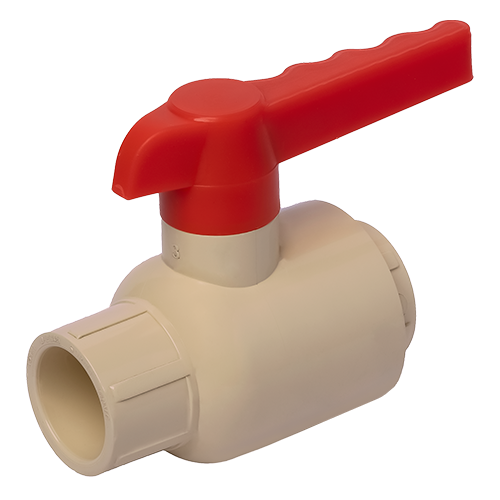
The CPVC ball valves are made of several crucial components designed to deliver a leak- proof, efficient flow-
The body of these valves are made of CPVC material which is known for its chemical – resistance and strength.
Ball is usually made of CPVC or chrome- plated materials with a precision bore that enables flow regulation.
These are often composed of PTFE (Teflon) which ensures minimal friction and a tight seal.
Handles are usually manual actuators and are made of high- impact plastic or metal.
It connects the handle to the ball, thus, enables rotation for opening and closing.
These are the detachable ends to ensure easy installation, servicing and replacement.
Working Mechanism of CPVC Ball Valves
The operation of the CPVC Ball Valves is based on the quarter-turn principle which works as follows-
The bore in the ball aligns with the pipeline, allowing the fluid to pass.
The ball rotates 90 degrees, and the bore is perpendicular to the flow path, stopping the fluid.
This simple and effective mechanism allows for a quick shut-off and flow control which makes ball valves ideal for isolation tasks.
| CPVC Ball Valve Price | |||||||
|---|---|---|---|---|---|---|---|
|
Size |
Product Code |
Packing Details |
MRP (Indian Rupees) |
||||
|
Inch |
mm |
Plain
|
Inner Box
|
Standard Pack
|
Per Pcs. |
||
|
½” |
15mm
|
PL15C
|
– |
– |
– |
||
|
¾”
|
20mm
|
PL20C
|
36
|
288 |
INR 140 |
||
|
1″
|
25mm
|
PL25C
|
25
|
200
|
INR 218 |
||
|
1 ¼”
|
32mm
|
PL32C
|
– |
130
|
INR 440 |
||
|
1 ½”
|
40mm
|
PL40C
|
– |
105
|
INR 700 |
||
|
2″
|
50mm
|
PL50C
|
– |
64 |
INR 1080 |
||
Applications
Due to its versatility, CPVC valves are in use in several industries-
The CPVC ball valves are widely used in residential, commercial and industrial buildings for piping systems carrying hot water.
The chemical inertness of CPVC valves make them ideal for handling corrosive fluids, acids and alkalis.
The CPVC ball valves are used in chlorination and water softening processes due to CPVC’s resistance to chemicals and bio- fouling.
They ensure hygienic, contamination-free fluid flow, especially in systems requiring high-temperature cleaning.
These are preferred for transporting sterile water and chemicals since CPVC does not leach harmful substances.
Due to its high heat resistance and low thermal conductivity, CPVC is ideal for HVAC systems and CPVC fire sprinkler piping systems.
They are resistant to chlorinated and saline water, withstanding long-term submersion and frequent exposure to chemicals.
Key Material Benefits & Advantages
CPVC ball valves, when in use, offer several key benefits-
CPVC can withstand the fluid temperatures of up to 93°C (200°F). This makes the valves made of CPVC material ideal for hot water systems, unlike traditional uPVC valves.
Since these materials are significantly lighter than metal alternatives, the CPVC valves are easier to install, transport and maintain. This significantly reduces overall labor and handling costs.
Since they deliver high durability and resistance at a lower cost than many metal valves, the CPVC ball valves offer a unique balance between performance and price.
Unlike metal valves, CPVC does not conduct heat effectively. Due to their property of being a non- conductor of heat, using the valves of these materials help in maintaining fluid temperature consistency and improves energy efficiency.
CPVC exhibits high resistance to bases, acids, salts, chlorinated solvents and hydrocarbons and thus, making it perfect for aggressive environments.
CPVC ball valves do not rust or corrode, even in hard water or saltwater applications. Further, they have smooth internal surfaces that reduce scaling and ensure long-term efficiency of flow.
Precision-engineered seats and seals provide long- lasting leak resistance even in high- pressure or high- temperature environments.
Since CPVC valves are Non- Conductor of Electricity, they are ideal for applications in environments sensitive to electrical conduction, thereby improving safety in installations near electrical systems
Limitations of CPVC Ball Valves
Despite the advantages it offer, CPVC valves also have certain limitations which require conscious attention, when in use-
The CPVC ball valves can become brittle and become prone to cracking at temperature below -100C. Thus, these are not suitable for usage in cold climates.
These are generally suitable for systems operating at a pressure up to 150 PSI at ambient temperature, but this decreases with rising temperatures.
Prolonged exposure to sunlight can degrade CPVC, causing discoloration and surface embrittlement. Outdoor applications require UV-stabilized variants or protective coverings.
CPVC material is brittle and thus, the CPVC ball valves are not suitable for high- pressure compressed gas applications.
Installation Best Practices
To ensure optimal performance and long durability of CPVC ball valves, it is mandatory to follow the correct installation procedure. Thus, following best practices are recommended-
-
Use compatible fillings
Use only CPVC - compatible solvent cement and primer to ensure proper bonding is done and that the joints are leak- free.
-
Allow Curing Time
Do not rush to test the system immediately. Let the cement cure for the recommended duration before testing the system.
-
Avoid excessive torque
Over- tightening often leads to cracks, leaks, etc. it is, therefore, advisable to not over- tighten the same so as to avoid any damage.
-
Pipeline support
Provide adequate support to piping systems to prevent valve body from cracking due to stress. Use pipe hangers or brackets to reduce mechanical stress on the valve body.
-
Allow for Thermal Expansion
It is crucial to note that CPVC expands with temperature and as such, provide for the same in the system design. Provide expansion loops or joints where required.
-
Avoid UV Exposure
If used outdoors, paint the valve with UV-resistant coating or use UV-shielded models.
Maintenance And Care Tips
Although CPVC ball valves require minimal maintenance yet following these practices can enhance their durability-
To prevent the valve getting stuck and thus ensuring smooth functioning, it is recommended to operate it occasionally, especially when the valve is not in regular use.
Ensure to always check and inspect for leaks, crackings, etc.
Periodically flush with compatible cleaning solutions especially in high- sediment water systems.
Use CPVC-safe lubricants if the valve becomes stiff.
Union-type valves allow easy replacement of seats or O-rings.
Standards and Certifications
Reliable CPVC ball valves conform to international and national standards, including:
American standards for CPVC fittings
Potable water safety certifications
International standards for thermoplastic valves
Fire-retardant classification
Indian Standard for CPVC pipes and fittings
Comparison Between CPVC Vs. UPVC Vs. RPVC Ball Valves
|
Feature |
CPVC |
UPVC |
RPVC |
|
Max Temp |
93°C |
60°C |
60°C |
|
Strength |
Higher |
Moderate |
High |
|
Cost |
Higher |
Low |
Moderate |
|
Chemical Resistance |
Excellent |
Good |
Excellent |
|
Best For |
High-temp chemicals |
Domestic, irrigation |
Industrial use |
|
Ideal For |
High- temperature chemical flows |
General purpose, cost-sensitive projects |
Industrial and heavy-duty uses |
Why Ashok Polymers?
CPVC Ball Valves are a trusted solution for fluid control in corrosive chemical applications, hot water systems and industrial piping networks. With their impressive temperature tolerance, chemical resistance and ease of use, they offer a compelling alternative to traditional metal valves and other plastic variants.
By choosing the right valve type and adhering to proper installation and maintenance practices, CPVC ball valves can provide years of reliable, leak-free performance. Whether you’re an homeowner, engineer or contractor, a deeper understanding of the benefits and applications of CPVC ball valves allows for an effective fluid management in any setting.
Reach out to us at Ashok Polymers to receive the right information and get resolution to all your queries and concerns.
Ashok Polymers have a market edge in manufacturing excellence, thus ensuring that each valve is
- crafted under strict quality control
- certified by industry standards, and
- backed by customer trust.
We are committed to more than just supplying valves- we are enabling smart flow solutions.
