
 Call Us Now!
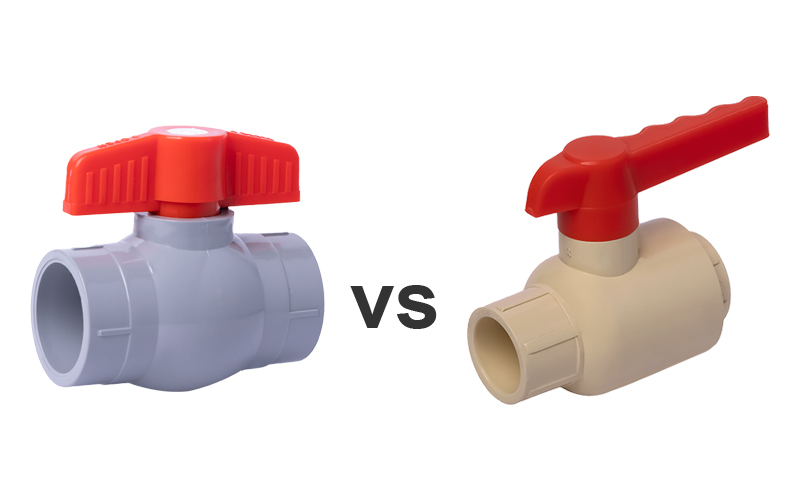
Stand at the counter of any plumbing supply store in India and ask for a ball valve, and you will likely be shown two visually similar products — one dark grey, one light beige or cream — both made from PVC-based material, both priced differently, and both described by the salesperson in terms that may not fully explain why one costs more than the other. This is the RPVC ball valve vs CPVC ball valve decision, and it is one of the most common points of confusion for homeowners, plumbers, and even procurement teams specifying valves for commercial projects. The confusion is understandable. Both RPVC and CPVC are PVC-based thermoplastics, both look broadly similar, both are sold as ball valves in overlapping size ranges, and both are marketed with similar language around durability and chemical resistance. But the difference between them is not cosmetic — it is a fundamental material property difference that determines whether a valve will survive in a specific application or fail within months. This guide provides a complete, practical comparison between RPVC ball valves and CPVC ball valves: what each material actually is, how their properties differ across temperature, pressure, chemical resistance, and cost, which specific applications favour each material, the installation differences that matter, the common mistakes that lead to premature valve failure, and a simple decision framework you can apply to any project. By the end, you will be able to specify the correct valve material with confidence — for your home, your farm, or your industrial facility.
Table of Contents
ToggleWhy the RPVC vs CPVC Decision Trips Up So Many Buyers
The root cause of confusion between RPVC and CPVC ball valves is that both materials share the same chemical family — both are derivatives of polyvinyl chloride — and both are marketed using overlapping terminology. RPVC, which stands for Reinforced PVC (sometimes also referred to in the market simply as rigid uPVC), and CPVC, Chlorinated Polyvinyl Chloride, are frequently displayed side-by-side on hardware store shelves with price tags that differ by 30 to 60 percent, but with packaging that often fails to clearly explain why.
This ambiguity has real consequences. The most common — and most costly — mistake is selecting RPVC for a hot water application because it appears visually similar to CPVC and costs less. RPVC valves installed on geyser outlets, hot water recirculation lines, or any application where water temperature regularly exceeds 50 to 60 degrees Celsius will soften, deform, and eventually fail at the joints — sometimes within weeks of installation. The reverse mistake — specifying CPVC for every application regardless of temperature — is less catastrophic but wastes budget, since CPVC’s price premium delivers no functional benefit in cold water applications.
Beyond the headline temperature difference, RPVC and CPVC also differ in pressure derating behaviour, chemical resistance at elevated temperatures, fire performance, and the specific solvent cement required for installation — each of which has practical consequences for how the valve performs and how long it lasts in service. This guide works through each of these differences systematically, starting with what each material actually is.
What is RPVC? Material, Properties & Manufacturing
RPVC — Reinforced PVC, also commonly marketed simply as rigid PVC or uPVC (Unplasticised PVC) — is the foundational rigid thermoplastic used across plumbing, irrigation, and drainage applications worldwide. The term ‘reinforced’ in common market usage typically refers to the rigid, unplasticised formulation that gives the material its structural strength, as distinct from flexible PVC compounds used in hoses and cable insulation.
RPVC is manufactured from PVC resin compounded with stabilisers, impact modifiers, and processing aids, then extruded or injection-moulded into pipes, fittings, and valve bodies. The resulting material offers high tensile strength (50-55 MPa), excellent corrosion resistance, broad chemical compatibility at ambient and moderately elevated temperatures, and a long service life — typically 15 to 25 years — in applications within its temperature range.
Key Properties of RPVC
- Maximum continuous service temperature: approximately 60°C, with practical pressure-bearing applications generally limited to below 45-50°C
- Tensile strength: 50-55 MPa, providing good impact and mechanical resistance at ambient temperatures
- Chemical resistance: excellent against most acids, alkalis, and salts at temperatures within its operating range
- Corrosion: completely immune to rust, scaling, and electrochemical corrosion in any water chemistry
- Cost: the most economical rigid PVC-based valve material, serving as the baseline for cost comparison with CPVC
- Manufacturing standards: IS 9890 (India) for ball valves, IS 4985 for UPVC pressure pipes
Where RPVC Excels
RPVC is the default, economically optimal choice for the very large category of applications operating at or near ambient water temperature: domestic cold water supply, agricultural irrigation, drainage and waste systems, swimming pool plumbing, and the cold-water sections of virtually any plumbing system. Given that the majority of water supply and distribution applications in residential, agricultural, and many industrial settings operate at ambient or near-ambient temperatures, RPVC serves as the correct specification for the majority of total valve volume in most projects.
What is CPVC? Material, Properties & Manufacturing
CPVC — Chlorinated Polyvinyl Chloride — is produced by post-chlorinating PVC resin, increasing the chlorine content from approximately 57 percent in standard PVC to between 63 and 69 percent. This additional chlorination is the defining structural change: it raises the glass transition temperature of the polymer, which directly translates to a higher safe operating temperature for the finished product.
CPVC valves and pipes are manufactured through a similar extrusion and injection moulding process to RPVC, but using the chlorinated resin and a different formulation of stabilisers and processing aids optimised for the higher-temperature processing and service requirements. The result is a material that retains the corrosion immunity and broad chemical resistance of PVC-based materials, while extending the safe continuous service temperature from approximately 60°C (RPVC) to 93°C (CPVC).
Key Properties of CPVC
- Maximum continuous service temperature: 93°C, more than 30°C higher than RPVC
- Pressure retention at elevated temperature: CPVC retains a significantly higher percentage of its rated pressure as temperature increases, compared to RPVC
- Chemical resistance: equal to or exceeding RPVC, maintained across a wider temperature range — meaning CPVC resists chemicals at temperatures where RPVC would already be too soft to hold pressure
- Fire performance: higher Limiting Oxygen Index (approximately 60 vs approximately 45 for RPVC), giving CPVC better self-extinguishing characteristics — the basis for its use in fire sprinkler systems
- Cost: typically 30 to 60 percent higher than equivalent RPVC valves, reflecting the additional processing required to chlorinate the base resin
- Manufacturing standards: ASTM F439 (Schedule 80 CPVC fittings), ASTM D1784 (CPVC compound classification), IS 15778 (India, CPVC pipes for hot and cold water)
Where CPVC Excels
CPVC is the correct — and in many cases the only viable PVC-based — specification for any application where water or process fluid temperature regularly or periodically exceeds 50 to 60°C. This includes residential and commercial hot water supply (geysers, hot water recirculation), industrial hot water and process heating systems, chemical processing lines that operate warm, fire sprinkler systems, and any sanitisation cycle that uses hot water or steam-adjacent temperatures to disinfect process equipment.
RPVC vs CPVC: Full Side-by-Side Comparison
With both materials introduced, here is a comprehensive side-by-side comparison across every factor relevant to selecting a ball valve material:
| Property | RPVC Ball Valve | CPVC Ball Valve |
|---|---|---|
|
Full Material Name |
Reinforced / Rigid PVC (uPVC-based) |
Chlorinated Polyvinyl Chloride |
|
Max Continuous Temp |
Up to 60°C |
Up to 93°C |
|
Pressure Rating (SCH80) |
Up to 16 bar @ 23°C |
Up to 16 bar @ 23°C, derates faster with heat |
|
Chemical Resistance |
Excellent (cold/ambient service) |
Excellent across a wider temperature band |
|
UV Resistance |
Available in UV-stabilised grades |
Available in UV-stabilised grades |
|
Cost (relative) |
Lower — 100 (baseline) |
Higher — approx. 130-160 of RPVC cost |
|
Color (typical) |
Dark grey / black |
Light grey / cream / beige |
|
Impact Strength |
High — good for mechanical stress |
Slightly lower than RPVC at room temp |
|
Solvent Cement Type |
PVC solvent cement |
CPVC-specific solvent cement required |
|
Fire / LOI Rating |
Self-extinguishing (LOI ~45) |
Higher LOI (~60) — better fire performance |
|
Typical Service |
Cold water, irrigation, drainage |
Hot water, chemical process, fire sprinkler |
The comparison makes the core trade-off clear: RPVC offers lower cost and equally excellent performance for cold and ambient-temperature service, while CPVC offers a substantially higher temperature ceiling and better high-temperature pressure retention at a meaningful cost premium. Every other property — chemical resistance, corrosion immunity, UV stability when appropriately stabilised — is broadly comparable between the two materials within their respective temperature ranges. The decision, in the overwhelming majority of cases, comes down to one question: what is the maximum temperature this valve will experience in service?
Temperature Ratings Explained — The Single Biggest Decision Factor
If you take only one piece of information from this entire guide, it should be this: temperature is the dominant factor in the RPVC vs CPVC decision, and it interacts with pressure in a way that many buyers do not fully appreciate. Both materials lose pressure-bearing capacity as temperature rises — but they do so at very different rates, and RPVC’s pressure rating falls away much faster than CPVC’s as temperature increases.
The following table illustrates this derating behaviour using typical published derating curves for Schedule 80 RPVC and CPVC ball valves, expressed as a percentage of the valve’s rated pressure at 23°C (room temperature):
| Temperature | RPVC Pressure Rating (% of rated) | CPVC Pressure Rating (% of rated) | Notes |
|---|---|---|---|
|
23°C (73°F) |
100% |
100% |
Both at full rated pressure |
|
40°C (104°F) |
65% |
90% |
RPVC derates quickly above 30°C |
|
50°C (122°F) |
45% |
80% |
RPVC nearing its practical limit |
|
60°C (140°F) |
20% |
70% |
RPVC at absolute maximum — not recommended for pressure service |
|
80°C (176°F) |
Not rated |
45% |
RPVC unsuitable; CPVC still functional at reduced pressure |
|
93°C (200°F) |
Not rated |
25% |
CPVC upper continuous service limit |
The practical implication of this table is significant. A Schedule 80 RPVC ball valve rated for 16 bar at room temperature retains only about 20 percent of that rating — roughly 3 bar — at 60°C, which is at or below many domestic hot water system operating pressures. At the same temperature, the equivalent CPVC valve retains around 70 percent of its rating — over 11 bar — comfortably covering typical hot water system pressures. This is why CPVC is not simply ‘nicer to have’ for hot water applications; RPVC genuinely cannot provide adequate pressure-bearing capacity at hot water temperatures, regardless of the nominal pressure rating printed on the valve at room temperature.
Understanding 'Continuous' vs 'Intermittent' Temperature Exposure
An important nuance in temperature rating is the distinction between continuous and intermittent exposure. A valve that experiences brief excursions above its continuous rating — for example, a CPVC valve on a line that occasionally sees a short hot flush cycle above 93°C — may tolerate this without immediate failure, as the derating figures are based on long-term continuous exposure for rated service life. However, repeated excursions accelerate material ageing and reduce overall service life even if no immediate failure occurs. For RPVC, even brief exposure to temperatures above 60-70°C can cause visible softening and permanent deformation, making RPVC unsuitable for any application with even occasional hot water exposure — including situations where hot and cold water lines might inadvertently be cross-connected during installation.
Pressure Ratings and Schedule Classifications
Both RPVC and CPVC ball valves are manufactured in Schedule 40 (standard wall) and Schedule 80 (heavy wall) classifications, with Schedule 80 offering approximately 25-30 percent thicker walls and correspondingly higher pressure ratings at a given temperature.
Schedule 40 vs Schedule 80 — Both Materials
- Schedule 40 RPVC: typically rated to 10 bar at 23°C — suitable for standard domestic and agricultural cold water applications
- Schedule 80 RPVC: typically rated to 16 bar at 23°C — used for borewell pump outlets, high-pressure cold water mains, and buried applications with mechanical load
- Schedule 40 CPVC: typically rated to 10 bar at 23°C, derating to approximately 4 bar at 82°C — suitable for residential hot water distribution
- Schedule 80 CPVC: typically rated to 16 bar at 23°C, derating to approximately 7-8 bar at 82°C — used for industrial hot water systems and process lines requiring higher pressure at elevated temperature
The key takeaway is that the Schedule classification alone does not tell you the valve’s pressure rating at operating temperature — you must always cross-reference the Schedule rating against the temperature derating chart for the specific material (RPVC or CPVC) to determine the actual pressure capacity at your application’s operating temperature.
Chemical Resistance: RPVC vs CPVC in Real Applications
Both RPVC and CPVC offer excellent chemical resistance across a broad range of acids, alkalis, salts, and many organic compounds — and at room temperature, the chemical resistance profiles of the two materials are broadly similar. The practical difference emerges when chemical exposure occurs at elevated temperature.
Many chemical reactions and corrosion mechanisms accelerate with temperature — a chemical that RPVC resists comfortably at 25°C may attack RPVC more aggressively at 50°C, both because the chemical reaction rate increases and because RPVC’s own resistance to deformation decreases as it approaches its temperature limit. CPVC, by virtue of its higher temperature ceiling, maintains effective chemical resistance across a wider temperature range — meaning a chemical dosing line that runs warm (40-70°C) will generally perform better in CPVC even if the chemical itself is one that both materials resist at room temperature.
Practical Examples
- Sodium hypochlorite (chlorine) dosing at ambient temperature: both RPVC and CPVC perform well; RPVC is the economical choice
- Hot caustic cleaning solutions (CIP systems, 60-80°C): CPVC required — RPVC would soften under the combined thermal and chemical load
- Acid storage tank outlets at ambient temperature: RPVC is standard and cost-effective
- Acid transfer lines with process heating (40-60°C): evaluate based on specific acid and exact temperature — CPVC provides a safety margin as temperatures approach RPVC’s limit
When evaluating chemical resistance for a specific application, always check the chemical resistance chart for the exact chemical, concentration, AND temperature combination — a chemical compatibility rating that does not specify temperature is incomplete information for this decision.
Cost Comparison: Upfront Price vs Total Cost of Ownership
The upfront price difference between RPVC and CPVC ball valves of equivalent size and schedule typically ranges from 30 to 60 percent, with CPVC commanding the premium due to the additional chlorination processing step in manufacturing. For a project specifying hundreds or thousands of valves — an irrigation network, a residential development, or a commercial building — this percentage difference translates into a significant absolute cost difference.
When the Upfront Premium is Worth Paying
For applications genuinely requiring CPVC’s temperature performance, there is no cost-effective alternative — RPVC will fail, and the cost of that failure (water damage, repair labour, replacement valve and pipe sections, and potential consequential damage) vastly exceeds the upfront premium for CPVC. In these applications, CPVC’s premium is not a cost to be minimised; it is the cost of a functioning system.
When the Upfront Premium is Wasted
For cold water applications — the majority of valve points in most projects — specifying CPVC delivers no functional benefit over RPVC. The chemical resistance, corrosion immunity, and service life of RPVC in cold water service is fully adequate, and the CPVC premium simply increases project cost without improving performance. On a large project with, for example, 500 valve points where only 50 are on hot water lines, correctly specifying RPVC for the 450 cold water points and CPVC for the 50 hot water points — rather than CPVC throughout — can reduce total valve cost by 25 to 40 percent without any compromise in performance.
Total Cost of Ownership Considerations
Beyond the initial valve cost, total cost of ownership should account for: the cost of valve replacement if the wrong material is specified (RPVC on a hot line failing within months, requiring not just valve replacement but often pipe and joint repair due to the failure); the relative maintenance requirements (both materials require minimal maintenance when correctly specified, so this factor is largely neutral between them); and the consequences of any leak or failure in the specific application (a failed valve on a critical process line has a much higher consequential cost than a failed valve on a non-critical drainage line, which may justify a more conservative — i.e., CPVC — specification even in borderline temperature cases).
Application-by-Application: Which Valve Wins Where
Bringing together the temperature, pressure, chemical, and cost factors discussed so far, here is a practical application-by-application guide covering the most common scenarios where the RPVC vs CPVC decision arises:
| Application | Recommended | Why |
|---|---|---|
|
Cold water domestic plumbing |
RPVC |
Lower cost is decisive; temperature never exceeds 40°C |
|
Agricultural irrigation (drip/sprinkler) |
RPVC |
Cost across hundreds of valve points; cold water service only |
|
Geyser / water heater connections |
CPVC |
Water temperature regularly exceeds 60°C — RPVC will fail |
|
Chemical processing (ambient temp) |
RPVC |
Chemical resistance equal to CPVC at lower cost when temp stays below 50°C |
|
Chemical processing (heated lines) |
CPVC |
Required above 60°C; chemical resistance maintained at elevated temperature |
|
Industrial hot water / HVAC loops |
CPVC |
Continuous operation 60-93°C makes RPVC unsuitable |
|
Drainage and waste (SWR) |
RPVC |
Ambient temperature, no pressure requirement — RPVC is standard |
|
Fire sprinkler systems |
CPVC |
Listed CPVC required for fire-rated piping; RPVC not approved |
|
Swimming pool plumbing |
RPVC |
Pool water temperature stays within RPVC’s range; lower cost across long pipe runs |
|
Pharmaceutical hot water utility |
CPVC |
Process water often run hot for sanitisation cycles above 60°C |
|
Borewell / pump outlet (cold) |
RPVC |
High pressure but ambient temperature — Schedule 80 RPVC is correct and economical |
|
RO/water purifier hot flush lines |
CPVC |
Periodic hot water sanitisation cycles exceed RPVC’s safe range |
Notice the pattern: RPVC wins wherever the application is fundamentally a cold or ambient-temperature water service, regardless of pressure — because pressure derating is only a concern at elevated temperature. CPVC wins wherever hot water or elevated-temperature process fluid is present, even intermittently, because RPVC’s temperature limit is an absolute constraint that cost savings cannot overcome.
Installation Differences You Need to Know
While RPVC and CPVC ball valves are installed using broadly similar techniques — solvent welding, threading, or union connections — there are specific differences that installers must be aware of to achieve a reliable joint.
Solvent Cement Requirements
This is the single most important installation difference. RPVC (PVC-based) joints require PVC solvent cement, while CPVC joints require CPVC-specific solvent cement. The two cements have different chemical formulations because they are designed to soften and bond with the specific resin of each material. Using PVC cement on a CPVC joint — a common error when installers are not paying close attention to packaging — results in a joint that may appear to bond initially but will fail under pressure or thermal cycling because the cement has not properly fused with the CPVC surface.
Always verify the solvent cement container label explicitly states compatibility with the material you are joining. Many manufacturers produce ‘all-purpose’ or ‘universal’ cements that are formulated to work with both PVC and CPVC — these are acceptable, but a cement labelled specifically for PVC that does not mention CPVC compatibility should not be used on CPVC joints.
Primer Application
Both materials benefit from primer application before cementing, which cleans and slightly softens the joint surfaces for better cement penetration. CPVC primers are typically formulated for the higher-temperature service the joint will see and should similarly be matched to the material.
Thermal Expansion Allowance
CPVC has a higher coefficient of thermal expansion than RPVC, and because CPVC is used in hot water applications where the temperature differential between installation (ambient) and operating conditions can be 60-70°C, expansion allowance is a more critical consideration for CPVC installations. Expansion loops, offsets, or guided expansion joints should be incorporated into CPVC hot water pipe runs at intervals determined by the pipe diameter and expected temperature differential — consult manufacturer expansion tables. RPVC cold water lines experience much smaller temperature differentials (typically 10-20°C between installation and operating conditions) and require correspondingly less expansion allowance.
Colour Coding as a Quality Control Tool
The visual colour difference between RPVC (commonly dark grey) and CPVC (commonly light grey, cream, or beige) — while not a guaranteed standard across all manufacturers — can serve as a useful quality control check during installation. If a hot water line is being assembled and a fitting of the ‘wrong’ colour appears in the material pile, it is worth double-checking the material specification before installation. However, always verify material identity through manufacturer markings or certification rather than relying on colour alone, as colour conventions are not universally standardised.
Common Mistakes When Choosing Between RPVC and CPVC
The following mistakes account for the large majority of RPVC vs CPVC specification errors encountered in residential, agricultural, and industrial projects:
| Common Mistake | Why It Causes Problems |
|---|---|
|
Using RPVC on a geyser outlet to save cost |
Even brief exposure to water above 60°C softens and deforms RPVC, causing joint failure and leaks within months. The cost saved is lost many times over in repair and water damage. |
|
Using PVC solvent cement on CPVC joints |
Standard PVC cement does not properly bond CPVC — the chemical composition is different. This creates joints that appear sealed initially but fail under pressure or thermal cycling. |
|
Assuming CPVC is ‘just a stronger RPVC’ |
CPVC is not a universal upgrade — for cold water and ambient-temperature service, RPVC offers equal performance at lower cost. Specifying CPVC everywhere wastes budget without functional benefit. |
|
Ignoring pressure derating at elevated temperature |
Both materials lose pressure rating as temperature rises, but RPVC derates much faster. A valve rated 16 bar at 23°C may be rated for only 3-4 bar at 60°C in RPVC — verify against manufacturer derating charts. |
|
Mixing RPVC and CPVC fittings in the same line |
While both are PVC-based, RPVC and CPVC fittings should not be solvent-welded directly to each other without a proper transition fitting — different cement requirements and slight dimensional differences can compromise the joint. |
Decision Framework: How to Choose in 5 Questions
For any valve specification decision between RPVC and CPVC, work through these five questions in order. In most cases, the answer becomes clear by question 2.
- What is the maximum temperature this line will ever experience — including occasional or intermittent excursions, not just normal operating temperature? If the answer is above 50°C with any regularity, or above 60°C even occasionally, CPVC is required. If the line is permanently below 45°C, RPVC is appropriate.
- What is the operating pressure at that maximum temperature — not at room temperature? Cross-reference against the temperature derating tables in Section 5 to confirm the chosen material’s pressure rating at the actual operating temperature exceeds the actual operating pressure with an appropriate safety margin.
- Is this a critical line where a failure would have significant consequences (water damage, process downtime, safety risk)? If yes, and the temperature is borderline (45-55°C), consider specifying CPVC for the additional safety margin even if RPVC might technically be adequate — the cost difference is small relative to the consequence of failure.
- Are there hundreds or thousands of similar valve points in this project where the cost difference will compound significantly? If yes, ensure the temperature assessment in question 1 is done rigorously for each distinct line type, so that RPVC is correctly specified for all genuinely cold-water points rather than defaulting to CPVC ‘to be safe’ across the entire project.
- Does the application involve any regulatory or certification requirement — fire sprinkler listing, pharmaceutical water system certification, or similar — that mandates a specific material regardless of temperature? If yes, the regulatory requirement overrides the temperature-based decision; confirm the required material and certification before specifying either option.
Our Recommended RPVC and CPVC Ball Valve Range
Ashok Polymers manufactures and supplies both RPVC and CPVC ball valves, giving you a single source for correctly specifying both cold water and hot water / chemical process applications within the same project — without needing to source from multiple suppliers or compromise on material quality for either category.
Our RPVC ball valve range covers Schedule 40 and Schedule 80 from 1/2 inch through 4 inch, manufactured to BIS IS 9890 standards, ideal for domestic cold water plumbing, agricultural irrigation, drainage systems, and ambient-temperature industrial applications. Our CPVC ball valve range covers the same size range in Schedule 40 and Schedule 80, manufactured to ASTM F439 dimensional standards with a continuous service rating to 93°C, suitable for hot water systems, chemical processing lines, and applications requiring elevated temperature performance.
Both ranges are available with solvent weld, threaded, and true-union end connections, and our technical team can help review your project’s line-by-line temperature and pressure requirements to ensure the correct material is specified at every point — avoiding both the safety risk of under-specified RPVC on hot lines and the unnecessary cost of over-specified CPVC on cold lines.
Ashok Polymers supplies residential developers, agricultural infrastructure projects, industrial plants, and plumbing contractors across India, with bulk pricing available for projects requiring both material types across multiple valve points. Browse our complete RPVC and CPVC ball valve range on our product page to download datasheets, temperature derating charts, and request a project quotation.
Frequently Asked Questions (FAQs)
The main difference is temperature rating. RPVC (Reinforced/Rigid PVC) is rated for continuous service up to approximately 60°C and is the lower-cost option, suitable for cold and ambient-temperature water applications. CPVC (Chlorinated PVC) is rated for continuous service up to 93°C due to its higher chlorine content, making it the required choice for hot water and elevated-temperature chemical applications, at a 30-60% cost premium over RPVC.
No. RPVC ball valves should not be used for hot water applications above approximately 50-60°C. At these temperatures, RPVC softens significantly and loses most of its pressure-bearing capacity — a Schedule 80 RPVC valve rated for 16 bar at room temperature may retain only 3 bar of capacity at 60°C, which is inadequate for typical hot water system pressures. Use CPVC for any application involving water above 50°C.
No, CPVC is not universally better — it is better for high-temperature applications, but for cold and ambient-temperature water service, RPVC offers equivalent chemical resistance, corrosion immunity, and service life at a lower cost. Specifying CPVC for cold water applications adds cost without functional benefit. The correct choice depends entirely on the operating temperature of the specific line.
RPVC valves are commonly dark grey or black, while CPVC valves are commonly light grey, cream, or beige — though colour conventions vary by manufacturer and should not be relied upon as the sole identification method. The most reliable way to identify the material is to check the manufacturer’s markings on the valve body, which typically indicate the material (PVC/RPVC or CPVC) along with the relevant standard (IS 9890, ASTM F439, etc.).
RPVC and CPVC fittings should not be directly solvent-welded to each other without an appropriate transition fitting, as they require different solvent cements and have slightly different dimensional tolerances. If a transition between RPVC and CPVC piping is needed — for example, where a cold water RPVC main connects to a CPVC hot water branch — use a manufacturer-approved transition fitting or union connection designed for this purpose.
Both RPVC and CPVC ball valves are commonly available in Schedule 40 (rated approximately 10 bar at 23°C) and Schedule 80 (rated approximately 16 bar at 23°C) classifications. However, this rating applies at room temperature — both materials derate as temperature increases, with RPVC derating significantly faster than CPVC. Always check the temperature-specific pressure rating for your application’s actual operating temperature, not just the room-temperature rating.
CPVC is the material used in listed fire sprinkler piping systems (under various UL and FM listings) due to its higher Limiting Oxygen Index and self-extinguishing properties. RPVC does not carry equivalent fire system listings and should not be used in fire protection piping. If your project involves fire sprinkler infrastructure, CPVC components with the appropriate fire listing are required regardless of the temperature consideration.
CPVC ball valves typically cost 30 to 60 percent more than equivalent RPVC valves. For a large project, the total cost impact depends on how many valve points genuinely require CPVC (hot water, fire protection, elevated-temperature chemical lines) versus how many are cold water points where RPVC is appropriate. Correctly specifying RPVC for all cold water points and CPVC only where temperature requires it — rather than defaulting to CPVC throughout — can reduce total valve cost by 25 to 40 percent on projects with a high proportion of cold water points.
Conclusion
The RPVC ball valve vs CPVC ball valve decision, despite the apparent similarity between the two materials, comes down to a single dominant factor: the maximum temperature the valve will experience in service, including occasional or intermittent excursions. RPVC, rated to approximately 60°C, is the correct, cost-effective choice for the large majority of cold and ambient-temperature water applications — domestic plumbing, agricultural irrigation, drainage, and ambient industrial process lines. CPVC, rated to 93°C, is required wherever hot water, elevated-temperature chemical processes, or fire protection system listings are involved.
Beyond temperature, this guide has covered the pressure derating behaviour that makes temperature and pressure interdependent, the chemical resistance considerations that become more nuanced at elevated temperatures, the cost trade-offs between upfront price and total project cost across many valve points, the installation differences — particularly solvent cement compatibility — that affect joint reliability, and a five-question decision framework that resolves the vast majority of specification decisions quickly and confidently.
Whether you are fitting out a single home, designing an irrigation network, or specifying valves for an industrial plant, applying the temperature-first framework in this guide will ensure you select RPVC where it is the economical and correct choice, and CPVC where it is the necessary one — avoiding both the safety risk of under-specification and the unnecessary cost of over-specification.
 Previous Post