
 Call Us Now!
 Valves are the unsung heroes of any piping system. They are responsible for regulating flow, maintaining pressure and ensuring safety. Among them all, when choosing for simplicity, reliability and effectiveness, the ball valve undoubtedly stands out.
There are several valves within the ball valve category as well. However, the single piece ball valve is a widely used variant and is popular for its cost- efficiency and compact design. This makes it especially popular in applications which prefer maintenance- free operation and budget- conscious solutions.
What is a Single - Piece Ball Valve?
A single- piece ball valve is also known as a one- piece ball valve. It is a type of quarter- turn valve that uses a hollow, perforated and pivoting ball to control the flow of fluid through a pipeline.
The ‘single- piece’ refers to the valve body since it is made from a single cast or forged piece of material and encloses the ball and seats within the structure. The body of a single- piece ball valve cannot be disassembled for maintenance, unlike the body of a two- piece or a three- piece valve.
As such, this design benefits by enhancing strength and minimizing leak paths but it also limits internal servicing.
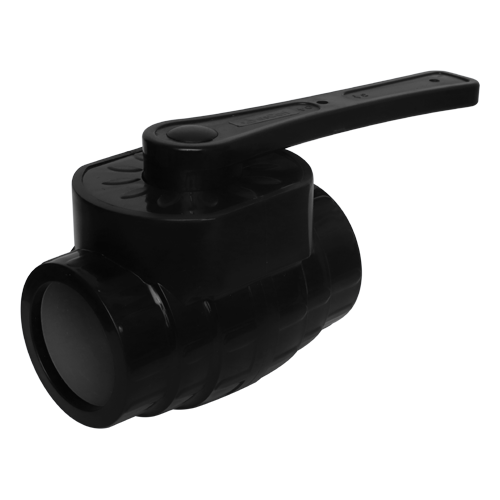
| Technical Details | |||||||
|---|---|---|---|---|---|---|---|
|
Size |
Product Code |
Packing Details |
|||||
|
Inch |
mm |
Plain |
Thread
|
Inner Box
|
Standard Pack
|
||
|
2″
|
63mm
|
I63P
|
I63T
|
– |
45
|
||
|
2 ½”
|
75mm
|
I75P
|
I75T
|
– |
30 |
||
|
3″
|
90mm
|
I90P
|
I90T
|
– |
22 |
||
Material and Construction
The Single – Piece ball valves are usually made of –
The body of these valves are made from a single piece of cast or forged metal or plastic and ensure high strength and minimal leakage points.
A ball is a spherical plug with a hole (bore) through the center that controls fluid flow.
Typically made from PTFE or similar materials, these provide a tight seal between the ball and valve body.
It enables manual or automated operation, usually through a 90° turn.
It connects the ball to the handle or actuator and facilitates rotation.
These prevent leakage along the stem.
Common Materials Used
Single piece ball valves can be made from various materials depending on the application.
Ideal for corrosion resistance in chemical, food, and marine environments.
Suitable for residential water systems and general purpose.
Used in oil & gas or high-pressure systems.
Lightweight, chemical resistant, and cost-effective for low-pressure systems.
Used in high chemical resistance applications.
Standard for chemical resistance and smooth operation.
Used based on chemical compatibility and temperature requirements.
Key Features of a Single - Piece Ball Valve
Single – piece ball valve have the following significant features –
Single- Piece material has lower cost as compared to two- or three-piece valves.
Integrated body of these valves ensure minimal space consumption.
Due to fewer body joints in a single- piece ball valve, it reduces the chances of external leakage.
The solid construction of these valves make it suitable for many industrial and domestic applications.
These are designed for systems where valve servicing is rare or not feasible.
Quarter- turn mechanism allows fast opening and closing of these valves.
Applications
Due to their cost-effectiveness and simplicity, single piece ball valves are widely used across industries-
- Water supply systems
- Irrigation pipelines
- Garden hose valves
- HVAC systems
- Water distribution networks
- Chemical processing (with appropriate material)
- Air and gas pipelines
- Cooling systems
- Drip irrigation control
- Fertilizer and pesticide pipelines
- Process water systems
- Cleaning systems (CIP)
- RO plants
- Effluent treatment systems
Advantages of Single- Piece Ball Valves
The single-piece body is easier to manufacture, reducing production costs and making it ideal for budget- conscious projects.
These valves are smaller and lighter than their multi-piece counterparts, making installation and transportation easier.
Fewer joints in the body mean a lower risk of leaks, especially at high pressures.
Minimal effort is needed to operate the valve, even under pressure.
Standard threaded or flanged ends allow for easy fitting into pipelines.
Limitations of Single - Piece Ball Valves
While suitable for many applications, single piece valves have certain drawbacks as follows-
The valve cannot be disassembled, thus, making internal maintenance impossible.
Sludge or particulates can cause wear since the valve cannot be cleaned internally.
Fewer options for specialized seats or trims.
Comparison: Single - Piece Ball Valve Vs. Other Types of Ball Valve Types
|
Feature |
Single Piece Ball Valve |
Two – Piece Ball Valve |
Three – Piece Ball Valve |
|
Cost |
Low |
Medium |
High |
|
Maintenance Ability |
Not serviceable |
Limited |
Fully serviceable |
|
Leakage Risk |
Very Low |
Low |
Medium |
|
Size & Weight |
Compact |
Medium |
Bulky |
|
Application Scope |
General-purpose |
Medium-duty |
Heavy-duty |
Installation Best Practices
For optimal performance and long durability of Single- Piece ball valves, following best practices are recommended –
-
Preparation
Verify size, pressure rating, and material compatibility. Ensure pipes are clean and cut square.
-
Threaded Valves
Use PTFE tape or pipe joint compound. Hand-tighten followed by a wrench, avoiding over-torquing.
-
Flanged Valves
Align flanges, insert gasket and tighten bolts in a star pattern.
-
Post-Installation
Open and close the valve to ensure smooth operation. Check for leaks by pressurizing the system gradually.
Maintenance Tips
Single- piece ball valves are not serviceable internally, they can be maintained externally to extend life-
- Operate periodically to prevent sticking.
- Keep the exterior clean and free from debris.
- Use the valve within specified pressure and temperature limits.
If leakage or obstruction occurs, the valve typically needs to be replaced.
Standards and Certifications
Quality single piece ball valves conform to various global standards-
American standards for dimensions and pressure.
European and international standards.
Petroleum industry applications.
British standard for ball valves.
Potable water approvals for domestic use.
Always ensure the valve you choose complies with local plumbing and safety codes.
Environmental and Safety Considerations
Single piece ball valves contribute to sustainable practices in several ways-
Single piece allows the structure to minimize water and energy wastage.
Metals and high- grade plastics can be recycled.
It reduces the need for frequent replacements, conserving resources.
Manufacturers are also adopting eco-friendly manufacturing methods, including low- emission forging and recyclable packaging.
Innovations and Industry Trends
The global ball valve market, including single piece variants, is witnessing several innovations-
Integration with IoT for monitoring and remote operation.
Use of lightweight yet strong polymers and alloys.
Complying with environmental regulations.
For precision applications in lab and medical systems.
Working of Single- Piece Ball Valve
The structure followed in manufacturing a ball valve is quite significant. The design of the valve is quite simple- it includes a ball which is spherical in shape and has a hole at the center and rotating the same within the body of the valve allows or blocks the flow of fluid.
In addition to a precise alignment of the structures of a ball valve, the criticality lies in the smooth functioning of the Quarter- Turn mechanism. In other words, the rotation of the ball at 900 is due to the quarter- turn mechanism that is responsible for regulating the flow of fluid within the system.
The ball inside the valve has a hole drilled through its center. When the handle is turned, it either allows the flow or blocks it. Here is the process for a clear understanding-
In this position, the handle is parallel to the pipe. The hole aligns with the flow direction, allowing fluid to pass through.
Here, the handle is perpendicular to the pipe. The solid side of the ball blocks the flow.
This quarter-turn mechanism is quick, efficient, and provides a reliable shutoff.
Why Ashok Polymers?
The single piece ball valve is a reliable, compact and economical solution for a wide variety of fluid control applications. It is ideal for situations where internal servicing isn’t a priority but long- term reliability is essential due to its sturdy, leak- resistant design.
Single piece ball valves continue to serve as a workhorse in the valve world, whether in residential plumbing, commercial HVAC systems or industrial pipelines. With the right material selection and proper installation, they offer years of trouble- free performance.
Curious to know more about single- piece ball valves? Reach out to us at Ashok Polymers to receive the right information and get resolution to all your queries and concerns.
Ashok Polymers have a market edge in manufacturing excellence, thus ensuring that each valve is
- crafted under strict quality control
- certified by industry standards, and
- backed by customer trust.
We are committed to more than just supplying valves- we are enabling smart flow solutions.
