 Call Us Now!
 The ball valves, in fluid control systems, are celebrated for their durability, a simple quarter- turn operation and excellent shut-off performance. Further, factors such as ease of installation, maintenance and reliability matters as well. Keeping these in mind, union ball valves stand out which enable quick access to the valve core without disturbing the surrounding pipeline. This makes them a great choice for use across systems like water treatment, plumbing, HVAC, industrial piping, chemical processing systems.
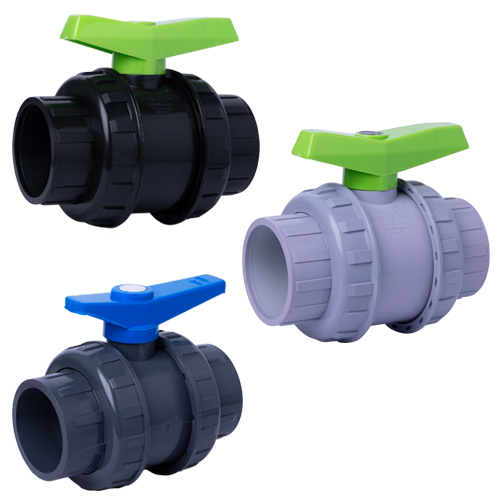
What is a Union Ball Valve?
- two mating flange- like ends attached to the pipeline, and
- a removable nut that clamps them together.
| Technical Details | |||||||
|---|---|---|---|---|---|---|---|
|
Size |
Product Code |
Packing Details |
|||||
|
Inch
|
mm
|
Plain |
Thread |
Inner Box
|
Standard Pack
|
||
|
1¼”
|
40mm
|
U40BP
|
U40BT
|
– |
105 |
||
|
1½”
|
50mm
|
U50BP
|
U50BT
|
– |
85 |
||
|
2″
|
63mm
|
U63BP
|
U63BT
|
– |
45 |
||
|
2½”
|
75mm
|
U75BP
|
U75BT
|
– |
36
|
||
|
3″
|
90mm
|
U90BP
|
U90BT
|
– |
20
|
||
| Specification | ||
|---|---|---|
|
Standard
|
DIN
|
|
|
Color
|
Black / Gray
|
|
|
End Connection
|
Plain / Thread
|
|
|
Body
|
Polypropylene (RP) / PVC
|
|
|
Ball
|
Polypropylene (RP) / PVC
|
|
|
Handle
|
100% Virgin Polypropylene / PVC / ABS
|
|
|
O-Ring
|
Nitrile Rubber
|
|
|
Seal
|
EPDM
|
|
|
Handle Cap
|
100% Virgin Polypropylene
|
|
Key Components and Construction
Union ball valves have the same core components as that of standard ball valves. However, these valves are augmented by the union joint. Here is a detailed structure of the same –
The valve body comprises the ball and the seats. These are usually made of stainless steel, brass, carbon steel, PVC, CPVC or PVDF and are chosen based on the compatibility of the material with the fluid and the respective temperature and pressure requirements.
Ball is a spherical obstruction with a through- bore. It rotates 90° (owing to the quarter- turn mechanism) to open or close flow. These are often chrome- plated (in metal valves) to ensure smooth operation while resisting corrosion.
Soft seats, often made of PTFE, RPTFE or PEEK, provide for a tight shut-off. Gaskets or O-rings at union faces ensure leak-free assembly.
The stem is the connector between the ball and the external control handle (the manual levers) or actuator (electric or pneumatic that automates operation).
The valve has two flanged ends matched with the sealing surfaces and are held together by a union nut. The nut has internal threads that tightly draw the two halves and compress a gasket or O-ring.
To prevent leakage, packing glands are placed around the stem. They can be of material such as PTFE, graphite, etc. and vary according to temperature and chemical exposure.
Working Mechanism of Union Ball Valves
Similar to standard ball valves, union ball valves works on the same quarter-turn mechanism –
When the handle or actuator is turned 90°, it aligns the bore of the ball with the pipeline. This is the open position which allows for full, unobstructed flow.
A further 90° turn rotates the ball and the bore is now perpendicular to the flow path. This creates a positive seal and closes the flow.
The primary benefit of the union connection lies in maintenance. At the time of servicing, the union nut is loosened and the valve body slides out while leaving the pipeline connections intact. Thus, the union connection has no effect on the fluid dynamics.
Applications
Union ball valves are of great use in sectors that have aggressive fluids or require regular maintenance and rapid replacement. As such, these are often used in the following systems –
These are often used in water treatment and distribution for functions such as filtration skids, pump inlet/ outlet isolation, backwash manifolds, etc.
These are also a great choice for systems where periodic inspection or seal replacement is routine. This involves chemical processing including acid, alkali, solvent lines.
Union ball valves also find their use in CIP (clean-in-place) systems where line disassembly must be minimized.
HVAC and chilled water systems often use union valves as pump and heat exchanger isolation valves which are often subjected to maintenance cycles.
Union valves are also chosen for low- pressure utility lines, sampling points, and skid- mounted equipment.
The marine and desalination often required corrosion- resistant alloys or plastic unions for seawater service.
Key Material Benefits and Advantages
Union ball valves have great advantages to use in different systems-
Union ends allow easy removal of the valve without cutting pipes. This reduces downtime and labor costs.
These are available in metals and plastics. They are versatile due to their compatibility with water, gases, chemicals and slurries.
Union valves are reliable since they provide for a tight shut- off, bi-directional sealing and low torque, thus ensuring secure isolation.
Their versatility allows for minimal system disruption, reduced labor and long service life. This yields a lower total cost of ownership.
Central cartridge or three- piece bodies of the union ball valves allow for quick seal or ball replacement.
They are easily retrofitted with pneumatic or electric actuators for remote or automated control.
Limitations of Union Ball Valves
Despite the unique benefits as offered by the union ball valves, there are a few limitations as well that should be taken into consideration before making a final decision-
The union ball valves have lower life- cycle costs. However, they are often costlier upfront as compared to the standard socket or threaded ball valves.
Union nuts and flanges require spaces. As such installation in tight spaces may require additional space clearance.
Union seals are reliable. However, they add an extra joint that requires correct and careful assembly with clean, undamaged gaskets.
Plastic unions are suitable for low- pressure and moderate- temperature systems.
Material Selection
Choosing the right Union Ball Valve is important and depends on several factors to consider-
|
Feature |
PVC / UPVC |
CPVC |
PVDF |
|
Temperature Range |
0°C to 60°C |
0°C to 93°C |
-40°C to 140°C |
|
Pressure Rating |
Up to 150 PSI |
Up to 200 PSI |
Up to 200 PSI |
|
Chemical Compatibility |
Acids, bases, salts |
Hot water, chemicals |
Strong chemicals, solvents |
|
Best For |
Irrigation, water treatment |
Hot- water plumbing, chemical handling |
Semiconductor, chemical processing |
Installation Best Practices
It is recommended to follow the best practices during the process of installation. This ensures optimal performance of the union ball valves, thereby impacting the long- term durability. The installation best practices are –
-
Inspect Gaskets & Threads
Ensure to check, at periodic intervals, if the union faces and gasket surfaces are clean and damage- free. It is recommended to lightly lubricate the threads, if required.
-
Tightening Sequence
Hand- tighten the union nut and then apply manufacturer- specified torque with a spanner. Make sure to avoid over- torquing.
-
Pipe Alignment
Misaligned pipes cause stress on the union joint. It is advisable to use flexible connectors or adjust piping to align union flanges.
-
Support and Anchoring
It is important to check that the valve should not bear unsupported loads. Making sure to support the pipeline weight independently is the key.
-
Pressure Testing
After installation, it is crucial to check for the leaks at union joints. As such, perform a hydrostatic test at 1.5x working pressure and check the same to make sure it is functioning correctly and smoothly.
Maintenance and Care Tips
When using union ball valves, follow these practices to enhance their durability-
Make sure to exercise the valve periodically to prevent seat sticking and verify smooth rotation.
Schedule a check to inspect for leaks, corrosion or wear at the union face and stem packing.
In case a slight stem leakage occurs, tightening packing gland nuts incrementally is recommended. However, if the leakage persists, replace the packing.
When using metal valves in aggressive environments, it is advisable to apply protective coatings. Otherwise, higher- grade alloys can also be chosen.
Standards and Certifications
Quality union ball valves often comply with-
Metal ball valves, flanged, lug, and buttwelding ends
Metal ball valves for petroleum, petrochemical, and allied industries
Valves—flanged, threaded, and welding end
Plastic (PVC, CPVC) fittings and valves
Plastic valve standards
Potable water approvals
It is advisable to always verify valves bear relevant markings and test certificates before making any purchase.
Why Ashok Polymers?
Union ball valves represent a maintenance- friendly, versatile solution for fluid isolation and control across industries. Their union connections guarantee unparalleled ease of access for inspection, repair and replacement. This not only minimizes the downtime but also lowers the labor costs.
Whether handling high-temperature fluids, potable water, compressed air or aggressive chemicals, choosing the right material, design and sealing option is a non- negotiable. This ensures reliable, leak-free operation. In addition, when proper installation and routine maintenance is being followed upon and the certified products from reputable manufacturers are selected, the union ball valves can potentially deliver decades of trouble- free service in your piping systems.
Resolve all your queries regarding Union Ball Valves TODAY! Reach out to us at Ashok Polymers to receive the right information and get resolution to all your queries and concerns.
Ashok Polymers have a market edge in manufacturing excellence, thus ensuring that each valve is
- crafted under strict quality control
- certified by industry standards, and
- backed by customer trust.
We are committed to more than just supplying valves- we are enabling smart flow solutions.
