
 Call Us Now!
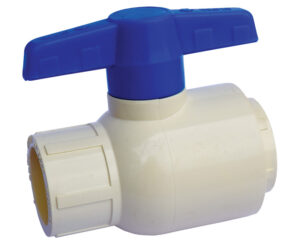
Standard PVC ball valves are workhorses of fluid handling — dependable, lightweight, chemically resistant, and cost-effective across a wide range of water and process applications. But they have one non-negotiable limitation: temperature. Push a standard PVC ball valve beyond 60°C, and its mechanical strength begins to decline, its seats deform, and its body can warp under pressure. For hot water systems operating at 70°C, 80°C, or even 93°C, PVC is simply the wrong material. This is precisely where CPVC ball valve applications in hot water systems become not just relevant but essential. Chlorinated Polyvinyl Chloride — CPVC — is an engineered evolution of standard PVC, modified at the molecular level through a chlorination process that raises its heat distortion temperature, improves chemical resistance, and enables reliable service up to 93°C at rated pressures. For building services engineers, industrial process designers, and plumbing contractors specifying hot water distribution systems, CPVC is the thermoplastic solution that closes the gap between standard PVC and expensive metal alternatives. This guide covers everything you need to know about CPVC ball valves in hot water applications — from the material science that makes CPVC work at elevated temperatures to the specific systems and industries where it delivers the most value, how it compares to PVC and metal alternatives, and the selection criteria that ensure you specify the right valve for your hot water system.
Table of Contents
ToggleWhat Is CPVC? The Material Science Behind the Performance
PVC (Polyvinyl Chloride) in its standard form contains approximately 56% chlorine by weight. CPVC is produced by passing chlorine gas through suspended PVC resin under UV radiation — a post-chlorination process that increases the chlorine content to 63–69% by weight. This additional chlorine content is not cosmetic; it fundamentally changes the polymer’s molecular structure in ways that directly translate into superior thermal performance.
How Chlorination Raises Thermal Performance
The chlorination process interrupts the regular repeating structure of the PVC polymer chain, creating a more random, irregular molecular arrangement. This irregularity raises the glass transition temperature — the point at which the material transitions from a rigid solid to a softer, more deformable state — from approximately 80°C for standard PVC to over 100°C for CPVC. The practical result: a CPVC ball valve retains its structural integrity, dimensional stability, and pressure-bearing capacity at temperatures that would cause a standard PVC valve to soften, deform, or fail.
CPVC Key Material Properties
| Property | Standard PVC | CPVC (FlowGuard / Astral Grade) |
|---|---|---|
|
Chlorine Content |
~56% by weight |
63–69% by weight |
|
Max Service Temp. |
60°C (140°F) |
93°C (200°F) |
|
Heat Distortion Temp. |
~72–80°C |
~100–110°C |
|
Tensile Strength |
~48–52 MPa |
~52–58 MPa |
|
Pressure Rating (at 23°C) |
PN6–PN16 (size dependent) |
PN10–PN16 (size dependent) |
|
Chemical Resistance |
Good — wide range |
Excellent — broader range |
|
Flame / Smoke Rating |
Self-extinguishing |
Self-extinguishing |
|
Thermal Conductivity |
Low (0.16 W/mK) |
Low (0.14 W/mK) |
|
Relevant Standards |
IS 4985, ASTM D1785 |
IS 15778, ASTM F441, ASTM D2846 |
One further advantage of CPVC’s low thermal conductivity is energy efficiency in hot water distribution. CPVC pipework loses significantly less heat to the surrounding environment than copper or steel — reducing heating energy consumption in buildings with long hot water distribution runs.
CPVC vs PVC vs Metal: A Direct Comparison for Hot Water Systems
Engineers and contractors specifying valves for hot water systems typically evaluate three material groups: standard PVC, CPVC, and metals (copper, stainless steel, gunmetal/bronze). Understanding where each material excels — and where it falls short — prevents costly specification errors.
CPVC Ball Valve vs Standard PVC Ball Valve — Hot Water System Comparison
| Property | Standard PVC Ball Valve | CPVC Ball Valve |
|---|---|---|
|
Max Temperature |
60°C — unsuitable above this |
93°C — full rated service |
|
Pressure at 70°C |
Significant derating — risky |
Retains good pressure rating |
|
Body Material |
Unplasticised PVC (uPVC) |
Chlorinated PVC (CPVC) |
|
Hot Water Plumbing |
Not recommended |
Approved and recommended |
|
Chemical Resistance |
Good |
Excellent — broader pH range |
|
Cost |
Lower |
10–25% higher — justified by performance |
|
Colour Coding |
Grey or white |
Cream / light yellow (industry standard) |
|
Joining Method |
CPVC solvent cement NOT compatible |
CPVC-specific solvent cement required |
CPVC vs Metal Valves in Hot Water Systems
| Comparison Factor | Metal Valves (Copper / SS) | CPVC Ball Valves |
|---|---|---|
|
Corrosion Resistance |
Susceptible to scale, galvanic corrosion |
Fully corrosion-resistant |
|
Weight |
Heavy — increases pipe support cost |
Lightweight — reduced structural load |
|
Thermal Expansion |
Lower coefficient |
Higher — requires expansion loops |
|
Installation Speed |
Slower — threading / soldering |
Faster — solvent cement jointing |
|
Cost |
Significantly higher |
30–60% lower installed cost |
|
Biofilm / Scale Risk |
Moderate (copper) to High (GI) |
Very low — smooth bore surface |
|
Suitable Temp. Range |
High — copper to 110°C+ |
Up to 93°C — most hot water duties |
|
Electrical Conductivity |
Conductive — isolation fittings needed |
Non-conductive — no galvanic risk |
Key Insight
For hot water systems operating between 60°C and 93°C, CPVC ball valves occupy the optimal value position — delivering the temperature performance of metal valves at a fraction of the installed cost, while avoiding the corrosion, scaling, and electrical conductivity issues associated with copper and steel pipework.
CPVC Ball Valve Temperature and Pressure Ratings
The most critical performance parameter for any hot water valve is its pressure-temperature (P-T) rating — the maximum safe working pressure at a given operating temperature. For CPVC ball valves, this relationship must be understood before any system design is finalised.
Pressure-Temperature Derating for CPVC Ball Valves
Like all thermoplastic valves, CPVC exhibits reduced pressure-bearing capacity as temperature increases. This derating is predictable and well-characterised, allowing engineers to confirm suitability for any operating condition within the material’s range.
| Operating Temperature | Typical Max Working Pressure (DN25–DN50 CPVC Ball Valve) | Notes |
|---|---|---|
|
23°C (ambient) |
PN16 (16 bar) |
Cold water service — full rated pressure |
|
40°C |
PN14 (~14 bar) |
Warm water / low-temp HVAC circuits |
|
60°C |
PN10 (~10 bar) |
Standard hot water supply systems |
|
70°C |
PN8 (~8 bar) |
Domestic HWS, hospital LTHW |
|
82°C |
PN6 (~6 bar) |
Process hot water, industrial duties |
|
93°C |
PN4–5 (~4–5 bar) |
Maximum rated service — verify per manufacturer |
Critical Design Rule
Always design your CPVC hot water system using the P-T rating at the MAXIMUM operating temperature — not the ambient installation temperature. A CPVC ball valve rated PN16 at 23°C must not be assumed to hold 16 bar in a 75°C hot water circuit. For 75°C service at typical domestic HWS pressures of 4–6 bar, a standard CPVC ball valve is fully adequate — but the calculation must be done.
Thermal Expansion: Planning for It in CPVC Systems
CPVC has a linear thermal expansion coefficient of approximately 6.3 × 10⁻⁵ m/m°C — higher than metal but lower than standard PVC. In a 10-metre run of CPVC pipe heated from 20°C to 80°C (ΔT = 60°C), the expansion is approximately 38mm. Ball valves in CPVC hot water systems must be positioned to accommodate this movement — either through directional changes in the pipework, expansion loops, or dedicated expansion joints adjacent to fixed valve stations.
Key Applications of CPVC Ball Valves in Hot Water Systems
CPVC ball valves serve a broad range of hot water applications across residential, commercial, and industrial sectors. The following application profiles represent the most common and highest-value uses in the Indian and global market.
A. Domestic Hot Water Supply Systems (HWS)
Residential and commercial buildings with centralised hot water generation — whether from gas, electric, or solar water heaters — require isolation valves at every connection point: inlet and outlet of the water heater, branch takeoffs to bathrooms and kitchens, and zone isolation in multi-storey buildings. Standard PVC valves on these systems routinely fail within two to three years due to thermal cycling stress. CPVC ball valves, correctly specified, deliver ten to fifteen years of reliable service in the same conditions.
- Typical sizes: DN15 to DN32 for residential; DN40 to DN80 for commercial properties
- Operating conditions: 60–75°C supply temperature, 2–6 bar system pressure
- Connection type: Threaded BSP or socket-end for residential; flanged for large commercial plant rooms
- Recommended seat material: EPDM for standard hot water; PTFE where chlorine treatment levels are high
B. Solar Hot Water Systems
Solar thermal collectors generate hot water that can reach 70–90°C in the secondary circuit, depending on the collector type, weather conditions, and system design. The primary circuit connecting the collector array to the storage tank is one of the most thermally demanding environments for plastic valves — high temperature combined with pressure cycling from daily heating and cooling cycles. CPVC ball valves are the thermoplastic valve of choice for solar hot water system isolation and circuit balancing.
- Primary circuit temperatures can reach 85–95°C — confirm P-T derating for your specific valve before installation
- Use union-end CPVC ball valves at the collector array for easy seasonal maintenance access
- Specify PTFE seats for primary circuit valves due to higher temperature and thermal cycling frequency
- Install CPVC ball valves with stainless steel stems rather than brass for installations using non-copper collector arrays to avoid galvanic contamination risk
C. Hotel and Hospital Hot Water Distribution
Healthcare and hospitality buildings are legally required in many jurisdictions to maintain hot water at a minimum of 60°C at the point of delivery to prevent Legionella bacteria proliferation. This means the entire hot water distribution network — from the calorifier plant room to the furthest outlet — must be designed for continuous 60–65°C service. CPVC ball valves are specified throughout these systems for zone isolation, calorifier inlet/outlet control, and branch line isolation at every service riser.
- Anti-Legionella compliance requires continuous 60°C minimum — CPVC rated for this; standard PVC is not
- Hospital-grade systems often use thermostatic mixing valves (TMVs) downstream of CPVC isolation valves — confirm material compatibility at the connection interface
- Specify full-bore CPVC ball valves on distribution mains to minimise pressure drop over long pipe runs
- Quarterly valve cycling protocol should be embedded in the building maintenance schedule to prevent seat seizing
D. Industrial Process Hot Water
Manufacturing processes across food and beverage, pharmaceuticals, textiles, paper, and chemical industries routinely require process hot water at temperatures from 60°C to 90°C for washing, sterilisation, product processing, and equipment cleaning. CPVC ball valves serve as isolation and control elements on process water lines where the combination of elevated temperature and chemical exposure would rapidly degrade standard PVC but does not justify the full cost of stainless steel or titanium.
| Industry | Hot Water Application | Typical Temp. | Recommended CPVC Seat |
|---|---|---|---|
|
Food & Beverage |
CIP wash water circuits |
70–80°C |
EPDM (FDA compliant grades) |
|
Pharmaceuticals |
WFI and purified water loops |
65–80°C |
PTFE (extractable-free) |
|
Textile |
Dye bath feed and drainage lines |
75–90°C |
EPDM |
|
Paper / Pulp |
White water hot circuit |
60–75°C |
EPDM |
|
Chemical Process |
Hot water jacket circuits |
65–85°C |
PTFE (chemical resistance) |
|
Dairy |
Pasteurisation water circuits |
72–75°C |
EPDM (FDA grade) |
E. HVAC Chilled and Low-Temperature Hot Water Circuits (LTHW)
Modern HVAC systems increasingly use four-pipe configurations with both chilled water and low-temperature hot water circuits in the same plant room. While metal pipework remains common on large main distribution headers, CPVC ball valves have become standard on branch connections, fan coil unit (FCU) and air handling unit (AHU) connections, and smaller secondary distribution circuits — particularly in refurbishment projects where reducing weight and installation time is prioritised.
- LTHW circuits typically operate at 60–80°C flow / 50–70°C return — within CPVC’s rated range
- CPVC eliminates galvanic corrosion risk when mixing system materials in refurbishment projects
- DN15 to DN50 CPVC ball valves serve the majority of FCU and AHU branch connections
- Insulate all CPVC hot water pipework — reduces heat loss and prevents external surface temperatures from causing handling burns in occupied plant rooms
F. Geothermal and Heat Pump Systems
Ground-source heat pump systems and air-source heat pump units generate hot water outputs in the range of 45–65°C in standard heating modes, with some high-temperature heat pumps reaching 80°C. The secondary circuit connecting the heat pump to the hot water storage and distribution system is well within CPVC’s performance envelope. CPVC ball valves on these systems offer corrosion immunity and long service life in plant rooms where condensation and humidity levels are typically high.
CPVC Ball Valve Selection Criteria for Hot Water Service
Not all CPVC ball valves are equally suited to hot water service. The following selection criteria help you specify the right valve for your specific application conditions:
Criterion 1: Verify the P-T Rating for Your Operating Conditions
Obtain the pressure-temperature derating curve from the manufacturer — not just the nominal PN rating at ambient temperature. Confirm that the valve’s rated pressure at your maximum operating temperature exceeds your system’s maximum working pressure (MWP) by a minimum safety factor of 1.5.
Criterion 2: Select the Correct Seat Material
EPDM seats perform well in standard hot water service up to approximately 80–85°C and offer good resistance to mild chemical exposure. PTFE seats are the preferred choice for higher temperatures (up to 93°C), systems with aggressive chemical dosing (chlorine, acid descalants), and pharmaceutical or food-grade applications where extractable contamination from rubber seats must be eliminated.
Criterion 3: Specify Full-Bore for Main Line Applications
On hot water distribution mains and pump circuits, always specify full-bore CPVC ball valves. The elevated temperatures in hot water systems mean that any additional pressure drop from a reduced-bore valve contributes to circulation pump energy consumption and temperature drop across the distribution network. Full-bore valves maintain system hydraulic performance at negligible incremental cost.
Criterion 4: Choose the Right End Connection for the System
| End Connection Type | Best For | Hot Water Consideration |
|---|---|---|
|
Socket / Solvent Weld |
Primary connection on CPVC pipe systems |
Use CPVC-specific cement only — never standard PVC cement |
|
Threaded BSP |
Connection to metal equipment, water heaters |
Apply PTFE tape; allow for differential expansion at threaded interface |
|
True Union |
Plant rooms, solar systems, frequent maintenance |
Preferred — allows in-line removal without cutting pipe |
|
Flanged |
Large bore mains, pump connections, calorifiers |
Ensure flange gasket material is rated for hot water service |
Criterion 5: Account for Thermal Expansion in Valve Positioning
Position CPVC ball valves at directional changes in the pipework wherever possible — the change in direction naturally accommodates thermal expansion without imposing bending stress on the valve body or adjacent connections. Where straight runs require mid-run valve positions, install the valve between two pipe guides with an expansion loop on each side.
Criterion 6: Confirm CPVC Cement and Primer Compatibility
CPVC requires a dedicated CPVC solvent cement and, in most applications, a CPVC primer. Using standard PVC cement on CPVC joints in hot water service is one of the most common and dangerous installation errors — it creates a joint that appears sound at ambient temperature but fails progressively as the system reaches operating temperature. Always use the cement system specified by the pipe and valve manufacturer.
Installation Best Practices for CPVC Ball Valves in Hot Water Systems
Step-by-Step Installation Sequence
- Confirm pipe and valve are the same CPVC grade and standard (IS 15778 for Indian systems, or ASTM D2846 / F441 for imported systems). Do not mix different manufacturers’ CPVC systems without verifying cement compatibility.
- Cut the pipe square using a fine-tooth saw or CPVC pipe cutter — no burrs. Chamfer the cut end at 10–15 degrees to ease entry into the socket.
- Dry-fit the valve onto the pipe to confirm depth of engagement. Mark the insertion depth on the pipe with a pencil.
- Apply CPVC primer to both the pipe outer surface (to the depth mark) and the inside of the valve socket. Allow the primer to flash off for 30 seconds.
- Apply a full, even coat of CPVC solvent cement to the pipe and a thin coat to the valve socket. Do not allow the cement to puddle inside the socket.
- Insert pipe into valve socket with a quarter-turn twisting action and push firmly to the depth mark. Hold for 30 seconds minimum.
- Wipe away excess cement bead at the joint. Do not disturb the joint for a minimum cure time — typically 1 hour at ambient temperature; longer at temperatures below 15°C.
- Allow full cure (typically 24 hours at 23°C, or longer at lower temperatures) before subjecting the joint to full operating pressure or temperature.
Hot Water Commissioning Warning
Never subject freshly assembled CPVC joints to hot water immediately after installation. Full cure at ambient temperature must be achieved first. Pressurising a partially cured CPVC joint with hot water (60°C+) will cause the solvent cement to release before adequate molecular bonding has occurred, resulting in immediate joint failure.
Additional Installation Considerations
- Support CPVC pipework at closer intervals than metal — maximum span between supports is approximately 1.0–1.2 m for horizontal hot water runs to prevent sagging under thermal load
- Never clamp CPVC pipework rigidly — use saddle-type supports that allow longitudinal movement for thermal expansion
- Insulate all CPVC hot water pipework — both to conserve heat energy and to prevent surface temperatures exceeding 45°C in accessible areas
- In plant rooms with frost risk, drain CPVC hot water lines during extended shutdown periods — unlike metal, CPVC has limited freeze tolerance in pressurised conditions
Common Mistakes When Using CPVC in Hot Water Systems
Mistake 1: Using PVC Solvent Cement on CPVC Joints
Standard PVC cement does not create an adequate molecular bond with CPVC at hot water temperatures. The joint may appear sound during cold-water pressure testing but will fail progressively during thermal cycling. Always use CPVC-specific solvent cement and primer — this is non-negotiable.
Mistake 2: Installing Standard PVC Ball Valves in Hot Water Lines
This is the most frequent and costly error in hot water system valve specification. Standard PVC ball valves are not rated for hot water service above 60°C. Seat deformation, body warping, and leakage — especially during peak hot water demand when temperatures are highest — are the inevitable consequences. Specify CPVC throughout wherever temperatures exceed 55°C.
Mistake 3: Ignoring the Expansion Characteristics of CPVC
Designers familiar with metal pipework often underestimate CPVC’s thermal expansion. A CPVC hot water distribution run installed in a straight line without expansion accommodation will generate substantial end-load forces on valve bodies and fittings during temperature cycling — eventually cracking fitting sockets or valve bodies at their weakest points.
Mistake 4: Specifying Incorrect Pressure Class for Hot Water Temperature
Selecting a CPVC ball valve based on ambient-temperature pressure rating without applying P-T derating is a design error that creates systems operating beyond the valve’s actual rated capacity. Always verify the derating curve and design to the rated pressure at maximum operating temperature.
Mistake 5: Mixing CPVC and PVC in the Same Circuit Without Adequate Transition Fittings
Where CPVC transitions to PVC pipework — for example, where a hot water circuit connects to a cold water distribution system — always use purpose-made CPVC-to-PVC transition fittings. Do not rely on threading a CPVC valve directly into a PVC fitting socket with solvent cement — the two materials require different cements and have different thermal expansion rates that will cause the joint to fail over time.
Ashok Polymers CPVC Ball Valves: Hot Water Ready
Ashok Polymers manufactures and supplies CPVC ball valves specifically engineered for hot water system applications — from domestic solar water heater installations to large commercial and industrial hot water distribution networks. Our CPVC valve programme is designed to meet the precise requirements of engineers and contractors who need thermoplastic valve performance at high temperatures without compromising on quality or long-term reliability.
Ashok Polymers CPVC Ball Valve Programme Highlights
- Size range: DN15 (1/2″) to DN100 (4″) — covering domestic, commercial, and industrial hot water applications
- Temperature rating: Rated for continuous service up to 93°C — with full P-T derating data available for design verification
- Seat options: EPDM standard for general hot water service; PTFE available for chemical process, pharmaceutical, and high-temperature solar applications
- End connections: Socket/solvent weld, threaded BSP, and true union configurations — matching all standard CPVC pipe system interfaces
- Material compliance: CPVC compound conforming to IS 15778 and ASTM standards — verified chemical resistance data available on request
- Body construction: One-piece and two-piece body designs — two-piece preferred for hot water service to allow in-line seat inspection
- Full-bore design standard across the range — no hidden flow restriction for hot water distribution duties
Our technical team works directly with HVAC contractors, plumbing engineers, and industrial process designers to confirm the right CPVC valve specification for each project — from residential hot water to complex industrial hot water networks. Technical data sheets including Kv values, P-T derating curves, and chemical resistance tables are available for all products.
Internal Link Suggestion: Explore the Ashok Polymers CPVC Ball Valve range at ashokpolymers.com — with technical specification sheets and enquiry support.
Frequently Asked Questions (FAQs)
A CPVC ball valve is rated for continuous service up to 93°C (200°F) at reduced pressure. At standard hot water temperatures of 60–75°C, a quality CPVC ball valve retains a working pressure of 8–10 bar — more than sufficient for domestic and commercial hot water systems typically operating at 2–6 bar. Always check the manufacturer’s pressure-temperature derating table for your specific operating conditions before finalising the specification.
No. Standard PVC ball valves are not suitable for hot water lines operating above 60°C. At higher temperatures, the PVC valve body begins to soften, seats deform, and the valve will eventually leak or fail entirely. For any application where water temperatures exceed 55°C — solar systems, domestic HWS, LTHW circuits, industrial process water — always specify CPVC ball valves, which are purpose-designed for elevated temperature service.
The fundamental difference is thermal performance. CPVC contains 63–69% chlorine versus approximately 56% for standard PVC. This higher chlorine content raises the heat distortion temperature to over 100°C, enabling CPVC ball valves to maintain structural integrity, dimensional stability, and reliable sealing at temperatures where standard PVC valves begin to deform. CPVC also offers broader chemical resistance. The two materials are not interchangeable — they require different solvent cements and serve different operating temperature ranges.
Yes. CPVC pipe and fittings manufactured to IS 15778 are approved for use in potable hot water supply systems in India. IS 15778 specifies the material, dimensional, and performance requirements for CPVC pressure piping systems used in hot and cold water distribution within buildings. When specifying CPVC ball valves for potable hot water, confirm the valve manufacturer’s compliance with IS 15778 or the equivalent ASTM D2846 / F441 standard.
The most reliable method for transitioning from CPVC to metal pipework is to use purpose-made CPVC-to-metal transition fittings — typically a CPVC socket on one side and a female or male BSP metal thread on the other. For threaded connections directly into metal equipment (water heaters, pumps), apply PTFE tape to the CPVC threaded end and tighten to the recommended torque value — do not over-tighten threaded CPVC connections as the material, while strong, can crack under excessive rotational load. Never solvent-weld CPVC directly to copper — the differential thermal expansion will eventually cause joint failure.
With correct material specification, proper installation using CPVC-compatible solvent cement, and a routine maintenance programme (quarterly valve cycling and annual inspection), a quality CPVC ball valve in a domestic or commercial hot water system should provide ten to fifteen years of reliable service. In industrial hot water applications with more aggressive conditions — high temperature cycling, chemical exposure, or continuous high pressure — a realistic service life is six to ten years before seat replacement or valve renewal is warranted.
PTFE seats are strongly recommended for CPVC ball valves on solar hot water primary circuits. Solar primary circuits experience the highest temperatures (potentially 85–93°C at peak solar input), the most frequent thermal cycling, and are often exposed to higher concentrations of dissolved minerals and, in some systems, antifreeze solutions. PTFE seats are chemically inert across this full exposure range, dimensionally stable at elevated temperatures, and have better long-term seating performance under thermal cycling conditions compared to elastomeric EPDM seats.
Conclusion: CPVC Is the Smart Choice for Hot Water Valve Specifications
For any fluid system operating above 60°C — whether a domestic solar water heater, a hospital hot water distribution network, a hotel calorifier plant room, or an industrial process water circuit — CPVC ball valves deliver the thermal performance, chemical resistance, and long service life that standard PVC simply cannot match.
The material science is clear: CPVC’s elevated chlorine content raises its heat distortion temperature above the operating range of virtually all hot water systems encountered in building services and light industrial applications. The economic case is equally clear: CPVC installed cost is 30–60% below equivalent metal pipework, with lower maintenance burden, zero corrosion risk, and a service life that matches the design life of the building or plant it serves.
At Ashok Polymers, our CPVC ball valve range is engineered specifically for the demands of hot water service — with full P-T derating data, EPDM and PTFE seat options, and technical support for every stage of your project from specification through commissioning. Visit ashokpolymers.com or contact our technical team to discuss your hot water system requirements.
Specify CPVC Ball Valves with Confidence
Ashok Polymers supplies CPVC ball valves DN15–DN100, rated to 93°C, with EPDM and PTFE seat options and full technical documentation for hot water system design.
 Previous Post
 Next Post